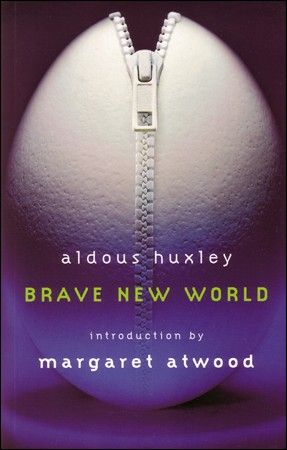
My high school had a thing for futuristic, dystopian novels. I was put through Fahrenheit 451, Anthem, and 1984. After my friend had to read Brave New World for her IB class and started complaining about it to me, I decided to read it myself. I can say that surpassed Brave New World surpassed Fahrenheit 451 as my favorite dystopian novel.
Aldous Huxley's novel presents an entirely different future from the one presented in Orwell's 1984. The contrasts between these two novels are summed up beautifully in Margaret Atwood's introduction to the Vintage Classics edition of this novel. Most striking is how Atwood shows how, in the early 2000s, both novels seemed to be edging ahead in the race of "What will our future really look like?" race. At the beginning of 2010, having seen it all, I can say that both have elements present in our society, but as for which is actually winning the race, well... That's up to each person.
Brave New World presents a future of freedom in every sense of the term as defined by Plato in his Republic. Describing the ideal state, Plato sees democracy as very low on the scale of good politics, since it promotes Freedom, freedom being a lofty way of saying "the pursuit of pleasure". Brave New World indeed focuses on this pursuit of pleasure and freedom, but in a somewhat paradoxical way. Inhabitants of Huxley's future are encouraged to be sexually promiscuous, shop shop shop, and go to multiple entertainments (before going home and having some more sex). The family is abolished as obscene and obsolete. Mother is a dirty word. At the same time, citizens are created in laboratories and strictly conditioned and medicated to respect their proper place in the order. You can only wear a certain color depending on your class. You had better go to those community sings. You had better be sexually promiscuous. It's all very interesting to see how "free" the society is, while at the same time seeing how restricted it is by the higher ups, the World Controllers (I believe is the term, I don't have my book with me and it's been a while).
Of course, the old ways of those living without freedom are preserved in the reservations throughout the world. These reservations are host to those who have not yet been exposed to, or have totally rejected, the brave new world of zippicamiknicks and soma. Rather, the soma of the reservations are the rather extreme, self-mutilating religious ceremonies of the people on the reservation (in the one visited in the book, Native Americans). To the Brave New Worlders who visit, they are seen as disgusting and quaint, repulsive and yet interesting. It's sort of how you can feel going to a zoo and viewing the animals. You don't think you could ever be in their place, and maybe you even pity them for being animals and not knowing better, but being fascinated by them at the same time.
The main character of the novel is really one of three persons. Bernard Marx is an alpha who is rather discontent with his life. He doesn't really fit in with other citizens of the new nation. Then there is Lenina, who is beautiful and also sometimes doesn't fit in (for instance, her friend fears that she isn't being promiscuous enough and seeing enough men). Lastly, there is John the Savage, whose mother was a Brave New Worlder who got stranded in the reservations. John grew up knowing only the reservation life, but then is taken back by Bernard and Lenina to civilization as they know it. John, "the Savage" as everyone calls him, is an immediate hit and at first he is amazed and awed by the new world. Then, John grows disgusted with it all and reverts back to his more "savage" ways. Bernard, meanwhile, finds a rather peaceful, very non-MiniLove alternative to the brave new world in Iceland, and Lenina sort of fades into the background over the course of the novel.
Brave New World cautions us not against the all powerful, all controlling regime which is always watching us a la Big Brother, but rather a more subtle, less overt Big Brother. It is still a controlling and imperfect, horrific state, but on the surface, it looks absolutely wonderful. People can do whatever they care to and fly all around the world, see the "feely" movies, and shop till the drop. They can take soma to get away when they can't go anywhere else. But they also can't know about the world that came before this brave new one. For all the freedom they have, their own freedom is limited by the government in place in the novel.
Huxley's use of Shakespeare in the novel is also wonderfully done, but would require a whole new review just to talk about that. Rather than diving into every play and every reference, let me just mention my favorite, which is of course related to the title. Coming from The Tempest, Miranda at the end exclaims, "O brave new world, that has such people in it!". Having grown up in isolation on the island with only her learned father, Prospero, and the savage servant Caliban, the prospect of marrying Ferdinand and going to live in mainland Italy seems brave and exciting. Prospero, however, who knows the ways of the world and is at times cynical and harsh (just as the world really is), responds, "'Tis new to thee". These two lines sum up wonderfully the attitude of John the Savage through the novel. John starts off (in Bernard and Lenina's eyes) as a Caliban, being savage and uncultured but not really knowing it, except by a tiny little inkling. He then turns into a Miranda, becoming amazed and entranced by this new life. At the end, he becomes a Prospero, cynical and disgusted with the world as he has come to experience it.
Brave New World is an exceptional novel which warns against the subtle dystopia threatening our existence. Rather than startling us awake with messages of BIG BROTHER IS WATCHING YOU!! or paradoxical Freedom is Slavery slogans, Brave New World slowly startles us with its parallels to our modern world. For those of you who are into the dystopian, futuristic novel, this one is a rather refreshing, illuminating change from the harsh, cold and gray type of future presented in 1984.
I give Brave New World four and a half stars out of five.


