Friday, January 1, 2010

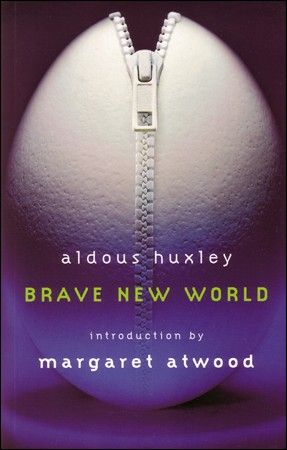
Book Review: Brave New World

(I'm spitting these things out like poppity-pop-pop to make up for lost time, as you can guess.)


My high school had a thing for futuristic, dystopian novels. I was put through Fahrenheit 451, Anthem, and 1984. After my friend had to read Brave New World for her IB class and started complaining about it to me, I decided to read it myself. I can say that surpassed Brave New World surpassed Fahrenheit 451 as my favorite dystopian novel.

Aldous Huxley's novel presents an entirely different future from the one presented in Orwell's 1984. The contrasts between these two novels are summed up beautifully in Margaret Atwood's introduction to the Vintage Classics edition of this novel. Most striking is how Atwood shows how, in the early 2000s, both novels seemed to be edging ahead in the race of "What will our future really look like?" race. At the beginning of 2010, having seen it all, I can say that both have elements present in our society, but as for which is actually winning the race, well... That's up to each person.

Brave New World presents a future of freedom in every sense of the term as defined by Plato in his Republic. Describing the ideal state, Plato sees democracy as very low on the scale of good politics, since it promotes Freedom, freedom being a lofty way of saying "the pursuit of pleasure". Brave New World indeed focuses on this pursuit of pleasure and freedom, but in a somewhat paradoxical way. Inhabitants of Huxley's future are encouraged to be sexually promiscuous, shop shop shop, and go to multiple entertainments (before going home and having some more sex). The family is abolished as obscene and obsolete. Mother is a dirty word. At the same time, citizens are created in laboratories and strictly conditioned and medicated to respect their proper place in the order. You can only wear a certain color depending on your class. You had better go to those community sings. You had better be sexually promiscuous. It's all very interesting to see how "free" the society is, while at the same time seeing how restricted it is by the higher ups, the World Controllers (I believe is the term, I don't have my book with me and it's been a while).

Of course, the old ways of those living without freedom are preserved in the reservations throughout the world. These reservations are host to those who have not yet been exposed to, or have totally rejected, the brave new world of zippicamiknicks and soma. Rather, the soma of the reservations are the rather extreme, self-mutilating religious ceremonies of the people on the reservation (in the one visited in the book, Native Americans). To the Brave New Worlders who visit, they are seen as disgusting and quaint, repulsive and yet interesting. It's sort of how you can feel going to a zoo and viewing the animals. You don't think you could ever be in their place, and maybe you even pity them for being animals and not knowing better, but being fascinated by them at the same time.

The main character of the novel is really one of three persons. Bernard Marx is an alpha who is rather discontent with his life. He doesn't really fit in with other citizens of the new nation. Then there is Lenina, who is beautiful and also sometimes doesn't fit in (for instance, her friend fears that she isn't being promiscuous enough and seeing enough men). Lastly, there is John the Savage, whose mother was a Brave New Worlder who got stranded in the reservations. John grew up knowing only the reservation life, but then is taken back by Bernard and Lenina to civilization as they know it. John, "the Savage" as everyone calls him, is an immediate hit and at first he is amazed and awed by the new world. Then, John grows disgusted with it all and reverts back to his more "savage" ways. Bernard, meanwhile, finds a rather peaceful, very non-MiniLove alternative to the brave new world in Iceland, and Lenina sort of fades into the background over the course of the novel.

Brave New World cautions us not against the all powerful, all controlling regime which is always watching us a la Big Brother, but rather a more subtle, less overt Big Brother. It is still a controlling and imperfect, horrific state, but on the surface, it looks absolutely wonderful. People can do whatever they care to and fly all around the world, see the "feely" movies, and shop till the drop. They can take soma to get away when they can't go anywhere else. But they also can't know about the world that came before this brave new one. For all the freedom they have, their own freedom is limited by the government in place in the novel.

Huxley's use of Shakespeare in the novel is also wonderfully done, but would require a whole new review just to talk about that. Rather than diving into every play and every reference, let me just mention my favorite, which is of course related to the title. Coming from The Tempest, Miranda at the end exclaims, "O brave new world, that has such people in it!". Having grown up in isolation on the island with only her learned father, Prospero, and the savage servant Caliban, the prospect of marrying Ferdinand and going to live in mainland Italy seems brave and exciting. Prospero, however, who knows the ways of the world and is at times cynical and harsh (just as the world really is), responds, "'Tis new to thee". These two lines sum up wonderfully the attitude of John the Savage through the novel. John starts off (in Bernard and Lenina's eyes) as a Caliban, being savage and uncultured but not really knowing it, except by a tiny little inkling. He then turns into a Miranda, becoming amazed and entranced by this new life. At the end, he becomes a Prospero, cynical and disgusted with the world as he has come to experience it.

Brave New World is an exceptional novel which warns against the subtle dystopia threatening our existence. Rather than startling us awake with messages of BIG BROTHER IS WATCHING YOU!! or paradoxical Freedom is Slavery slogans, Brave New World slowly startles us with its parallels to our modern world. For those of you who are into the dystopian, futuristic novel, this one is a rather refreshing, illuminating change from the harsh, cold and gray type of future presented in 1984.

I give Brave New World four and a half stars out of five.

Book Review: Pirate Latitudes

First off, I'd like to apologize sincerely for neglecting this blog. Unfortunately my schedule at college is really not helping me read books for fun. I've only read one book "for fun" while I was living at school, since getting out for break, I've read three. Also I am going to try to add a few movie reviews in here and there, just to try to stay constant with the updating. Not that I have m/any followers, but for the casual reader, or whatever... Without further ado, then.


Pirate Latitudes is a posthumous work by the author Michael Crichton, as you can likely guess since his name is bigger than the title of the work. The manuscript was found complete in his files after his death and I believe it is just recently/semi-recently published. In any case I got my copy at Costco for $12 off list price, and I am rather glad of that.

The story is basically that of one Captain Hunter, who, in 1665, sets off with a crew from Port Royal to the Spanish-held island of Matanceros, where there is a treasure ship port. He comes up with an ingenious, some say impossible, plan to capture the treasure and return to Port Royal. The crew of his ship encounters a formidable Spanish foe (who they thought would be guarding the fort of Matanceros) and other dangers after the attack on the fort. As well as this, there is a small plot line regarding the governor of the Jamaica Colony and his new secretary, which really only appears in the beginning and in the end, likely because the story focuses on the pirates.

The plot is basically a good adventure read. Hunter's crew is indeed motley, featuring different characters of different nationalities and ethnicities, showing how the pirate (or privateering) lifestyle really was based on a sort of equality with a somewhat democratic flair evidenced in different scenes throughout the novel. However, the characters of Hunter's crew really seem two dimensional and more there for variety. We get their names and back stories, but we never really get to know them as people. It is unfortunate, because they seemed to me more interesting than the character of Hunter himself.

Then, in the middle of the story, Pirate Latitudes pulls what I will call a "Pirates of the Caribbean 2". The story, which started out believable enough and firmly rooted in historical fiction, suddenly takes a turn for the "weird" when a supporting character, who we are introduced to halfway through the story and sort of floats in and out of the next few chapters, conducts some magic. Then the ship runs into a kraken. And then cannibals. Then the story goes back to its more "historical", so to speak, ways. It all seems very strange and as if it was just thrown in at random.

Another thing is the fact that Lady Almont (the aforementioned spell-casting character) shows up in the battle at Matanceros. This is plausible enough, as she is being held by the Spanish. However, she only appears in a few chapters here and there, mostly as a love interest for Hunter, and then vanishes again for periods of time. This is especially strange during the battle scenes. I found myself thinking, "What did they do with Sarah Almont?", and then she appears later on after the fight. It just seems rather strange and, though I suppose it could indeed happen and have happened back in the 1600s, rather strange and almost as more of a device to get her to Port Royal.

Another gripe I had with the book was that some characters who show up in the beginning then only show up later at the end. Of course this is because the middle of the work is about the pirates and not the Port Royal-ians, but it seems rather strange for these people to be mentioned in the beginning and then not again until the end, especially because some of them wind up playing key roles. This is just a nitpick on my part but it seemed odd to me, especially considering that some of the characters (like Hacklett, the governor's secretary) are presented one way in the beginning, and then entirely different in the end, with no real showing of how they arrived at point B from point A.

All in all, my general feeling once I had finished this book was that we got to know everyone's names and a few of their personality quirks, but we never got to know their motives or their reasoning besides the back stories that Hunter knows of them. I found it very hard to be very interested in any of the characters, except that of Lazue, but that is probably just because she is a female dressing as a man (a la Mary Reid and Anne Bonny) and I am a female reading the book.

On the whole, Pirate Latitudes is a rather enjoyable book. It made for a quick and entertaining read and really was fun to read, too. It wasn't very challenging in terms of what was going on, and aside from a few random scenes (the kraken, Hunter's musing on the word vincit stamped into the canons on his ship), the book generally seems to run at a flowing, smooth pace. However, the characters are somewhat under personalized and are really more identifiable based on the character traits (Lazue is the human telescope, able to see very well and very precicely; Don Diego is the munitions expert; Sanson is an expert killer; Bassa the Moor is the muscles).

Nonetheless, the book really is enjoyable. It's hard to make pirates boring and Crichton certainly does not make them boring at all. The story is interesting and captivating and made for an altogether light and enjoyable adventure about pirates, although at times it did leave me wanting more.

I give it three stars out of five.

Wednesday, August 19, 2009

Book Review: The Lady Elizabeth

The Lady Elizabeth is the second novel by English Historian-slash-writer Alison Weir. The first, Innocent Traitor, will be reviewed at a later date. ;D

The book covers the life of the future Queen Elizabeth I, starting when she is about three and ending when she finally ascends to the throne. The book is divided into three sections, each representing a different "chapter" in Elizabeth's life. The section entitled "The King's Daughter" covers the turbulent period of Elizabeth's life as the daughter of Henry VIII, from her being a princess to just a lady of high standing and the unsure state of being in the King's favor, as well as the experience of having four new step-mothers. The next section, "The King's Sister", covers the reign of Elizabeth's brother, Edward, and contains one of the larges scandals of Elizabeth's life, that with the Lord High Admiral Thomas Seymour. The final section, "The Queen's Sister", covers the dangerous period of Elizabeth's life when Queen Mary was on the throne, in which Elizabeth was imprisoned in the Tower of London and repeatedly suspected of treasonous plots, none of which she was actively a part of, but connected with against her will.

Alison Weir's historical knowledge and expertise on the subject really bring the book to life. Elizabeth's actual life story contains so much drama and intrigue that one might think artistic license is unnecessary or even too over the top, but Alison Weir throws in a "what if?" situation that many people gossiped about even in Elizabeth's own lifetime. Though Weir maintains that the rumors are unfounded and false, in a bit of artistic license she uses the rumors about Elizabeth's involvement with Thomas Seymour to provide more reason for why Elizabeth swears never to get married.

One of the rumors surrounding the scandal with Elizabeth and Seymour was that Elizabeth became pregnant with his child, and that he brought a blindfolded midwife to deliver the baby in an isolated country estate and then disposed of it. Though Weir as a historian holds these rumors to be just that, Weir as an author includes it in a surprisingly not-too-dramatic plot twist. Elizabeth in the novel experiences a miscarriage four months into her pregnancy and becomes considerably more cautious in her dealings with men (though she still enjoys a flirtation here and there).It is this episode in her past, as well as the fates of her mother, Anne Boleyn, and Jane Seymour, the woman Henry VII married after Anne's execution, that cause Elizabeth to fiercely avow that she will never marry in order to escape dying from childbirth or other complications of marriage.

The book is told mainly from Elizabeth's point of view but also contains some brief passages told by Mary, her sister; Kat Ashley, her nurse and primary caretaker; and various other people who played an important role in Elizabeth's life. The book is extremely well written and makes Elizabeth's life very accessible to modern-day readers, and the artistic liberties taken do not detract from the overall story, but present an extremely interesting and plausible "what if?" situation. Alison Weir's expertise as a historian and biographer of Elizabeth really shine in this novel, which is every bit as good as her first.

I give The Lady Elizabeth four and a half stars out of five.

If you enjoy The Lady Elizabeth, also check out Alison Weir's other novel, Innocent Traitor, and her non-fiction book, The Children of Henry VIII. All will eventually be reviewed here.

Tuesday, August 18, 2009

Album Review: The Real McKenzies 10,000 Shots

The Real McKenzies is a Scottish Punk-Folk Band from, I believe, Vancouver, British Columbia, Canada. Now you may be wondering, "what on earth is folk punk?" Well, the best analogy I can give you, which I saw online somewhere, is: It's like taking The Sex Pistols and throwing in a bagpipe. That's right. A BAGPIPE. The Real McKenzies have been around for thirteen or so years, give or take. They have, I believe five or six albums, all of which are mixes between traditional Scottish music and original compositions. My favorites off the albums are their revamped versions of the traditional Scottish songs, complete with the good ol' bagpipe and punk styled guitars and vocals.

10,000 Shots is my favorite album by the band, one that, for me, is a real treat to sit down and listen to start to finish. It was released in 2008, their second to last album released to day, and, to me, it really shows how far the band has come, and in a sense, how much the band has "matured" since they debuted with their eponymous album.

Starting off with Smokin' Bowl (a song about war) and Best Day Until Tomorrow (which to the best of my ear-knowledge contains no bagpipes, but wonderful vocals on the chorus), the album starts off in an almost upbeat manner. Then we get the first of our traditional songs, Will Ye No Come Back Again?, a song written in the mid-to-late 1700s after the defeat of Bonnie Prince Charlie (Charles Stuart, grandson of King James II of England) and his later escape to the Isle of Skye. As could be expected, bagpipes are in full force here, and the song expresses the wishing of the Scottish People for their true heir to the English Throne to return. Along with the bagpipes, the vocals and the guitar "solos" in between verses, specifically around the 1 minute park, are very good. As those who know their history know, Charlie never did return to Scotland or England and the Stuart rule in England was ended (the Hanoverian Dynasty began soon after).

The next song, Pour Descisions, is about the singer's life in Canada and about the choices he made in his life. The song is somewhat tongue-in-cheek, and sort of takes a look at a musician's life, how it's "not that cute at 53" (the singer's age, really) but how "you still wish you were me". The next track, I Hate My Band, is more of the same, in a sense: tongue-in-cheek humor about how the singer hates his bands for what they've done to his life, but how they're "good lads at heart". This song is also lacking in bagpipes but features a nice guitar solo about halfway through.

The next track is another traditional song, Farewell to Nova Scotia. As you can guess, this song is a sailor's farewell to his home, Nova Scotia. The bagpipes are back (as I am led to believe they are often in Nova Scotia...) and in all, the song has a very melancholy feeling to it, but the music itself sounds more upbeat and lively. It's an interesting combination to a very memorable tune, possibly one of my favorites on the album. Following this is another traditional song, Bugger Off, which is about telling the audience of a show and patrons of a bar to get the hell out. It's more of the somewhat sarcastic humor that it is apparent in many of the songs on the album.

10,000 Shots is a song about how after 10,000 shots, everyone looks the same. It's sort of a humorous song about what happens from drinking. 13, the next track on the album, is another biographical song about the band's thirteen years together. The Skeleton and the Tailor is about a rather cynical Tailor, bound to a wheelchair, who accepts a dare to spend the night in a supposedly haunted cemetery. As he sits and mends clothes in the graveyard, a skeleton appears and tries to kill him, which causes the tailor to regain the use of his legs forevermore.

Comin' Thro' the Rye is a song based off a Robert Burns poem, and I think most are familiar with it as a children's song (at least that is where I first heard it). I won't even pretend to know what it's about, seeing as I can't even decipher the lyrics to save my life. It's traditional and it's Scottish and you ought to enjoy it just for that. The Ale is Dear is the usual instrumental piece that showcases the band's bagpiper's ability, and the final song on the album is The Catalpa, a ballad about the escape of Irish prisoners in the then British penal colony of Perth due to a regatta that was going on that day.

This album is enjoyable and really shows how far the band has come since its first CD. I five 10,000 Shots Four and a Half stars out of Five.

For more information about the traditional songs:
Will Ye No Come Back Again?
Farewell to Nova Scotia
The Catalpa

Wednesday, August 12, 2009

Book Review 1: Pride and Prejudice and Zombies

I bet that everyone in the world (well, maybe mostly everyone) has heard about Pride and Prejudice, the timeless Jane Austen classic, be it through the 1995 movie with Colin Firth, the 2005 (? I think) movie with Kiera Knightly, or, of course, the book itself. And now, fans of Jane Austen can stimulate their brain (and eat it too) with this new "edition" of the beloved classic, now with "ultraviolent zombie mayhem".

The premise is simple: Take Pride and Prejudice, throw in some Zombies, and maybe one or two subtle sexual references (or maybe that was just me?). But the result is, actually, a very fluid, very smooth read. Of course, the scenes of zombie mayhem do seem somewhat forced, but on the whole, they don't actually seem that out of place. Bear with me.

The humor of this book, and what, in my opinion, made it one of the New York Times's best sellers, is that the inserted scenes are written in perfect Regency language. The author[s] transition wonderfully, in my opinion, from the story of Pride and Prejudice to the descriptions of zombies attacking and Lizzy and her sisters using their Shaolin skills to defeat them.

Another thing that makes this book worth your while is that the book actually maintains the class, and other, conflicts that are contained in Pride and Prejudice. In Pride and Prejudice and Zombies, the class conflicts are now conveyed through Lady de Bourgh's mockery of Chinese Shaolin, which the Bennet Sisters have learned, as opposed to the Japanese style of fighting zombies, which is more pricey to learn due to the cost of traveling to the islands. Still present, too, are Lizzy and Darcy's initials dislike and prejudices and Lydia's obsession with officers. Mr. Collins is as obsequious as always, and Mrs. Bennet's nerves are still paining her (no thanks to the threat of zombies). In short, many of the familiar aspects are in P&P+Z, though some are conveyed in a manner more easily accessible to the modern reader.

The book has received generally good reviews, rating four and a half stars on the Facebook ap weRead. I would recommend this book to any fan of Jane Austen with a sense of humor who can take their classics with a grain of salt, and also to those who may have read Pride and Prejudice and can only look back on it with intense dislike. It is a surprisingly easy read, but actually quite engaging (and it even has literary circle questions in the back!) and very funny, especially to fans of Jane Austen.

I give Pride and Prejudice and Zombies four stars out of five.

Post script: THIS BOOK HAS PICTURES! 8D

Thursday, July 23, 2009

Being an Introduction to the Nature of the Blog

This is my blog! It is shiny and new. It will be used to review books, movies, music, and more. It will not be a blog that will chronicle my daily life and trials and tribulations though it may comment upon my upcoming college classes.

Books that will be reviewed will include works from Classical Literature (such as Austen, Bronte, Dickens, &c), works from Contemporary Literature (works by modern authors, from the 1980s to the present), works for Children (such as Harry Potter) and works for Students (such as all those books I will have to read for my Foundation Year Programme at King's).

Music that will be reviewed will range all over the spectrum that is music, including but not limited to Classical, Celtic punk, Gregorian chant, Techno, and Alternative, but will generally not include Rap.

All posts shall strive to be insightful and honest, thoughtfully written and without bias but this cannot always be guaranteed. Hopefully there will be a book review once every two weeks, and a music review every week, though of course this will fluctuate with unforeseen changes in the great big thing called life.